
Perigee

There exists a myth, prominent in the literary world, of an objective standard for literary excellence; one whose criteria has nothing to do with a writer’s or reader’s identity or background. A glance at the submissions policy of a range of literary journals and magazines reveals many who take pride in “reading blind.” The assumption of this practice: by disregarding a writer’s name and bio when considering her work for submission, we create a fair basis from which to judge work–we eliminate bias in the reading process, we judge only by literary excellence.

However, artistic and literary aesthetics are not an algorithm, and “literary excellence” is not an infallible mathematics. In fact, this standard is based on a preponderance of white, cis-male, heteronormative writing that has been and still is central to the literary mainstream.

Recently, our poetry editor, Joey De Jesus, publicly criticized Rattle Magazine for its failure to regularly publish black and brown writers. This critique was consistent with Apogee’s mission to challenge the status quo in mainstream publishing. In response to Joey’s valid and warranted question (Rattle recently published an NYC poets issue in which all seventeen of the selected poets were white), the editor publicly dismissed Joey’s questions and insulted his work, calling it “overwrought”–language which many perceived as racially charged. This incident revealed disregard for writers of color and their concerns.

The ensuing conversation was one in which the “objective standard” was at issue–the editor believed he was simply publishing the best work in their submissions pile. This assumption attempts to strip the author of identity without considering the editor’s own identity in his editorial role. A blind reading is impossible when the reader has his own charged interpretation of the words on the page. This editor, and many others, work from the assumption that they have the authority on literary goodness without first considering the origins of their own preferences.

While Rattle later released a statement apologizing for the exchange, and expressing a commitment to re-examining its submissions policies and editorial guidelines, the incident raised questions about the logic of “blind submissions,” as the magazine’s NYC issue seemed to prove that, far from limiting bias, the policy maintained an unrepresentative status quo.

Historically and today, white male writers have been granted cultural access to publication and voice (both as writers and gatekeepers), and with it have been allowed to write the histories, perceptions, and voices of women and people of color. And, in both roles, they have time and again misrepresented POCs. Even allies with the best intentions should recognize that they are not doing anyone favors by speaking in the place of someone who is perfectly capable of speaking for themselves.

It’s also important to consider that literature doesn’t exist in a vacuum. It’s a cultural product and a part of a greater artistic and social conversation. An audience doesn’t read “blind” or “for merit,” they take authorial identity into consideration. Trying to strip a piece of literature from the  identity of the person who wrote it is pretending that it exists outside of the culture in which it was created.

Kazim Ali, a poet we published in Issue 05, phrased the problem this way: “Claiming to judge work solely based on literary merit is inherently and inescapably racist. There is…a lot of work to do in terms of taking a good long hard and critical look at the structures by which we privilege literary work and promote and develop new writers.”

How are literary standards determined? Through literature class syllabi, which disproportionately feature white male authors, ranging from middle school to graduate writing programs. Through well-read publications whose pages consistently show disparity in publishing women and writers of color. See the research of VIDA and Roxane Gay for proof.

In the past, Apogee has invited writers to comment on this problem through our Alternate Canon blog series (featuring writers Anelise Chin and Rachel Eliza Griffiths). By reading diversely, we come to see that it is not only content that is affected by perspective and identity, but voice, perspective, tone, diction, syntax, mood, and rhythm.

Blind submissions don’t actually protect writers from the existing prejudices of editors, and they alone do not contribute to editors reading inclusively.

There are valid reasons for doing blind submissions. Our friends at The James Franco Review are all about blind submissions in order to stop the cult of celebrity. The Atlas Review takes blind submissions, yet they remain committed to diversity in staffing and in solicitation. The gatekeeper’s role should not be understated here. To some extent their choices will always be subjective, favoring one over the other (and, usually, the known over the unknown), but creating a diverse staff to variegate the voices that appear in print often helps.

We polled some literary journals that have proved themselves to be committed to publishing diverse voices, either explicitly through their mission, or implicitly through the work they’ve put out, about whether they read submissions “blind.” Responses were along the lines of: “No, because we focus on publishing work by a very specific group,” and “No, because our journal’s mission promises that over half of our contributors are from underrepresented groups.” This signals to us that, at least at the present moment, maintaining a commitment to publishing marginalized voices means making some deliberate efforts.

Publications must reconsider the practices designed to create fairness and non-bias, and investigate those biases central to the judgment of “literary merit.” One strategy is to enshrine conscientious reading into your editorial guidelines. Apogee’s guidelines stipulate that accepted work should portray marginalized protagonists and characters in multi-dimensional ways; challenge mainstream stereotypes; and engage with and interrogate the status quo in the literary mainstream, and in society more broadly, either in content or through form.

Questions of position and personal experience are those which our editors take very seriously–not just in consideration of first person, nonfictional accounts, but also in our reading of poetry and fiction. But our work is not insular; it happens in conversation with the writers who entrust their work to us, and with the other literary publications and organizations doing good, hard work to keep this profession breathing. We do this for all of us.

–The Apogee Staff


CREATIVE NONFICTION: Philistines, by Whittier Strong

  Philistines Whittier Strong   T-shirts bearing offensive slogans are strictly forbidden. Shorts, hats, and jeans with holes in the knees may not be worn to class or chapel. For women, the hem of the skirt must fall below the knee at all times. The list of prohibitions went on and on. But nowhere in the Guide to Student Life was there any mention of how I must wear my hair. Throughout my high-school years, my mother didn’t allow my siblings and me to present ourselves in any way that might reflect poorly on her parenting skills. It didn’t keep me from dreaming, though. I had thought, perhaps, a streak of blue through my bangs, until a classmate talked me out of it. She was mindful of my tenuous place in the high-school food chain, and worried that such a style would appear too feminine. I could not appear feminine. But now, as a Bible-college freshman—an adult—I was at last granted follicular freedom. My school allowed its students the right to don mohawks, dreadlocks, and rainbow dye jobs on the premise that those of us who exercised this right were best equipped to evangelize those who dressed their tresses in...
Read More

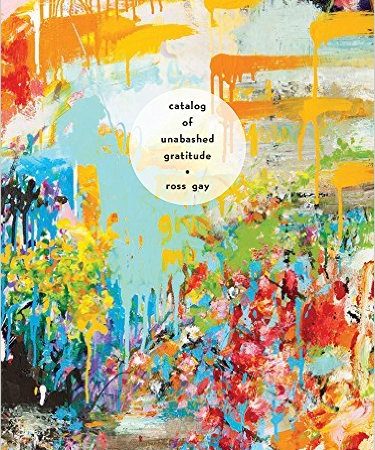
REVIEW: Catalog of Unabashed Gratitude, Claire Schwartz

  Ross Gay is the author three books of poetry: Against Which, Bringing the Shovel Down, and, most recently, Catalog of Unabashed Gratitude. The following book review concerns Ross Gay’s latest collection, Catalog of Unabashed Gratitude (University of Pittsburgh Press, February 2015). By Claire Schwartz   Listen to me. I am telling you a true thing. This is the only kingdom. The kingdom of touching; The touches of disappearing, things. –Aracelis Girmay, ‘Elegy’     There are no elegies in Ross Gay’s Catalog of Unabashed Gratitude. There are, of course, odes: “Ode to Buttoning and Unbuttoning My Shirt,” “Ode to the Flute,” “Ode to Sleeping in My Clothes,” “Ode to Drinking Water from My Hands”—not to mention the other poems not bearing the label, but nonetheless awash with gratitude. Crocuses and bees and bagpipes and ‘the quick and gentle flocking / of men to the old lady falling down’ are sanctified by the brush and burrow of thankfulness. As their titles make clear, Gay’s odes dwell in the ordinary, but in the poems’ vast ecologies, the quotidian surges toward the cosmological. The act of buttoning and unbuttoning a shirt gives rise to a meditation on the hand’s other gentlest pursuits:...
Read More

Battling Tsundoku and Charlie Rose

  Battling Tsundoku and Charlie Rose (An excerpt) By Alejandro Varela   Toni I ran into Toni Morrison once on a Beaux-Arts staircase in a sprawling building full of office suites, classrooms, and lecture halls shamelessly named after people whose primary accomplishment in life had been the accumulation of wealth. It was a couple of hours before a guest lecture that she was about to give, I later learned. The building was empty, except for her and I and her small retinue. She had an aura—nothing paranormal, but how could I possibly know for sure? Auras might be a natural consequence to having your voice validated so indisputably and overwhelmingly. Hi, she responded to my blank stare midway up the spiraled, neo-classical single helix. We shared the same step. We were Guanine. Paradise had just debuted to acclaim, but not the same acclaim of Beloved. I hadn’t read either. The next day I awoke steeped in regret. I’d missed a unique opportunity to embark on a lifelong friendship with a living legend. I set out to read all of Morrison’s books, in case there was a next time. The campus store didn’t have Tar Baby in stock, but I bought...
Read More

Arriving

  Arriving By Maritza Arrastia   This is an excerpt from  the beginning of the novel in progress Todos. It takes place in a fictional Caribbean island, half socialist and half a colony, that sits in the sea in relation to the metropolis, called the City, like Cuba sits in relation to key West. The collapse of capitalism is just a few degrees more acute than it is now. For two centuries Karaya, the  colony, has been fighting a  liberation war against the City. Socialist Ventura has been defending its revolution from unrelenting imperial attack for fifty years. The island is straddled by an imperial base, half of it in the colony and half of it in the socialist country. Many rebels have been disappeared there and a permanent demonstration has arisen beside it, where my protagonists have just arrived, a pod of two women in their sixties, one with her son who is 17,  and one with a six year old granddaughter, looking for Desaparecido loved ones who may have been disappeared in the base.   The driver dumped our duffels on the gravel and took off. Before we left the City my son Machi made the rule, one...
Read More

A Common Amnesia

  A Common Amnesia By Alex Cuff Originally published in Apogee Issue 4   But not yet have we solved the incantation of this whiteness, and learned why it appeals with such power to the soul; and more strange and far more portentous—why, as we have seen, it is at once the most meaning symbol of spiritual things, nay, the very veil of the Christian’s Deity; and yet should be as it is, the intensifying agent in things the most appalling to mankind. –Herman Melville, Moby Dick, 1851 white butcher paper wrapping the white bagel with the white sesame seeds inside white wax paper white spray paint tagging the framing store on metropolitan before 1691 the word white did not exist white letters of Brooklyn Seoul six white people in the bagel store white napkins the white Nissan sedan parked across the street left over dirty white snow before 1691 the word white did not exist in a legal document the white help wanted sign in the bagel store window me a white girl sitting under the bright white light bulb that many things I do or do not do think or do not think say or do not say...
Read More

One of His Advantages

  One of His Advantages By T.K. Dalton Excerpted from original publication on The Millions   Count weather among the forces that I move through life without understanding. What is its origin? What shapes its future? Parenting is humbling, and I end most days shuffling unwieldy questions like this, rarely dealing out anything like an answer. One frigid Saturday, wind and sleet scratched my plans to grocery-shop with my 16-month-old. He and I detoured, to our nearby library. More than basmati rice or cauliflower, in that moment he needed open space, the familiar thick carpet where he could squat and squeal freely. He needed the warm light of enormous lampshades embossed with ants, birds, and humpback whales. He needed more books. Actually, for different reasons, we both did. My son hadn’t tired of Good Dog, Carl or My Friends. He’d started requesting Tickle, Tickle by name. His mother invoked Knuffle Bunny while he handed her laundry, and Brush Your Teeth, Please had helped me transform a grim chore into something like dessert. (Grape-flavored toothpaste deserves some credit here). For weeks, maybe months, books had reliably engaged him, exciting or calming him depending on the title, the time of day, and...
Read More

A Pair of Chancletas

  A Pair of Chancletas By Elena Schwolsky   The sweet, sticky smell from an overflowing dumpster follows me as I turn the corner onto Calle Amistad—Friendship Street—but I smile to think of my dear friend of many years who I will see in a few short minutes. Threading my way around piles of dog shit and oily puddles from the afternoon rains, I walk in the street like everyone else––moving to the crumbling, narrow sidewalk only when a motorcycle, pedicab or antique car lumbers by. I remember how, years ago, when I first visited Havana in the early 90’s, no matter how hard I tried to fit in, boys would follow me down the block. “Chile!  Argentina!” they would call out, trying to match my fair skin to a country they knew.  Those were the days when few tourists visited Cuba and even fewer from the U.S.  Now, in 2012, no one gives me more than a curious glance. I am red-faced and sweaty by the time I get to Mari’s building. A group of girls is lounging in front of the beautiful old Art-Deco cigar factory across the street, recently transformed into a high school, their mustard yellow...
Read More

Worse than White

  Worse than White by Ginger Skinner   Abigail was born too light. Too light for her momma and aunties. All of them varying shades of deep brown and proud of it. “I don’t know how that child ended up so light. Everybody say her momma laid down with one of them Proctors over in Birchwood,” said Aunt Millie. “Just as pale as a ghost. Like a lil white girl,” added Aunt Colleen. Shavonne from sixth grade was inky dark just like Aunt Colleen and described Abigail the very same way.  It tended to ooze out of her mouth each time her fist met Abigail’s face. “Dumb ass white girl!” The last time it happened, Shavonne hooked Abigail’s leg with her foot just as she stepped off the school bus. Abigail landed hard, face first on the sidewalk, and all the fifth and sixth-graders watched as Shavonne hovered over her and spat out, “You think you better! Don’t you? Well, you ain’t.” Shavonne’s words bruised Abigail. Abigail had long blamed her father for her peachy-beige complexion and smattering of freckles. She’d suspected he was the culprit because she heard her momma once call him a “redbone devil.” And one time...
Read More

Writing in the Margins: Questioning

  Throughout this week, Perigee will be featuring writing from participants of  Apogee Journal and NY Writers Coalition’s first ever Writing in the Margins Workshop. On the first night of our eight week course we asked participants to write down questions: Questions about writing, writing and justice, writing and identity.  The goal was not to answer these questions, but rather to collectively identify what we need and want to question. To begin this series, we’d like to share these questions with you.     Social Justice Do you have to be angry to create good social justice writing? What is the goal (‘point’ seems too blunt) of writing with an awareness of social justice? Is it focused on the present, the near future, or the way future future? How do I write with urgency without being pedantic? (I.e. I want to help push a socialist revolution without anyone realizing it.) How do I use my writing as a tool for social change? Should writing be prioritized over organizing? Ah!! How can we imagine what collective liberation will look like? What gets in our human way of figuring out how to redistribute wealth? What do you read to start a revolution?...
Read More